
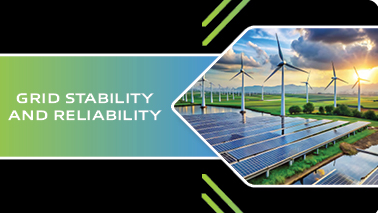
Grid Stability and Reliability have become the primary focus of energy policy as nations reach record levels of renewable penetration. In simple terms, stability is the grid's ability to maintain a consistent frequency (typically 50 or 60 Hz) and voltage, while reliability refers to the system's capacity to deliver power to every consumer without interruption. As traditional fossil-fuel plants which provided "natural inertia" via their massive rotating turbines are retired, the grid is losing its inherent mechanical cushion against sudden shocks, such as a cloud passing over a massive solar farm or a sudden surge in demand from AI data centers.
Statistically, 2026 is a year of unprecedented strain. Global electricity demand is rising at its fastest rate in decades (3.4% annually), driven by the "chip-to-grid" energy needs of high-performance computing and the rapid electrification of transport. By early 2026, the global grid automation and protection market has surged to approximately $118 billion. A critical trend this year is the widespread deployment of Grid-Forming (GFM) Inverters. Unlike older "grid-following" models that simply shut down during instability, GFM inverters actively "lead" the grid, using advanced firmware to emulate virtual inertia. This technology has become mandatory in regions like Rajasthan, India, and parts of South Australia, where renewable penetration frequently exceeds 100% of local demand.
The importance of grid reliability in 2026 cannot be overstated; even a millisecond of frequency deviation can cause billions in losses for semiconductor manufacturing or jeopardize life-support systems in hospitals. To combat this, utilities are investing in Synchronous Condensers giant spinning motors that provide mechanical inertia without burning fuel and massive Battery Energy Storage Systems (BESS). These batteries act as "digital shock absorbers," injecting or absorbing power in milliseconds to balance the grid. By integrating AI-driven predictive maintenance and "Self-Healing" digital substations, 2026 grids are becoming more resilient, capable of automatically isolating faults and rerouting power to ensure that the transition to a carbon-free future does not come at the cost of a dark screen.
Share this page on your timeline
ALSO READ Renewable Clean Energy Systems Solar Photovoltaic Technologies Floating Solar Systems Wind Energy and Wind Technologies Hybrid Renewable Energy Systems Bioenergy and Biomass Waste-to-Energy Technologies Geothermal Energy Systems Marine and Tidal Energy Smart Grids Power Systems Microgrids and Distributed Energy Resources Power Electronics for Renewable Integration Grid Stability and Reliability Cybersecurity in Power Systems AI and Machine Learning in Power Systems Digitalization of Energy Systems IoT Applications in Energy Advanced Battery Technologies Grid-Scale Energy Storage Long-Duration Energy Storage Thermal Energy Storage Systems Hydrogen Production and Storage Fuel Cell Technologies Sustainable Power Energy Efficiency Energy-Efficient Buildings Smart Cities and Energy Systems Energy Management Systems Industrial Energy Optimization Energy Transition, Policy Future Systems Decarbonization Pathways Net-Zero Energy Systems Carbon Capture, Utilization and Storage Circular Economy Energy Policy and Regulation Climate-Resilient Energy Systems Electric Mobility and Charging Infrastructure Vehicle-to-Grid Technologies Future Power System Technologies Hydro Power
Tags
Circular Economy Conferences Japan
Hydro Power Conferences Middle East
Green Hydrogen Conferences Europe
Bioenergy Conferences
Biomass Meetings USA
Green Hydrogen Technology Conferences
Renewable Clean Energy Conferences Middle East
Power Electronics Conferences Europe
Solar Energy Conferences 2026
Renewable Energy Conferences USA
Wind Energy Conferences
Sustainable Power Generation Meetings
Renewable Energy Conferences